
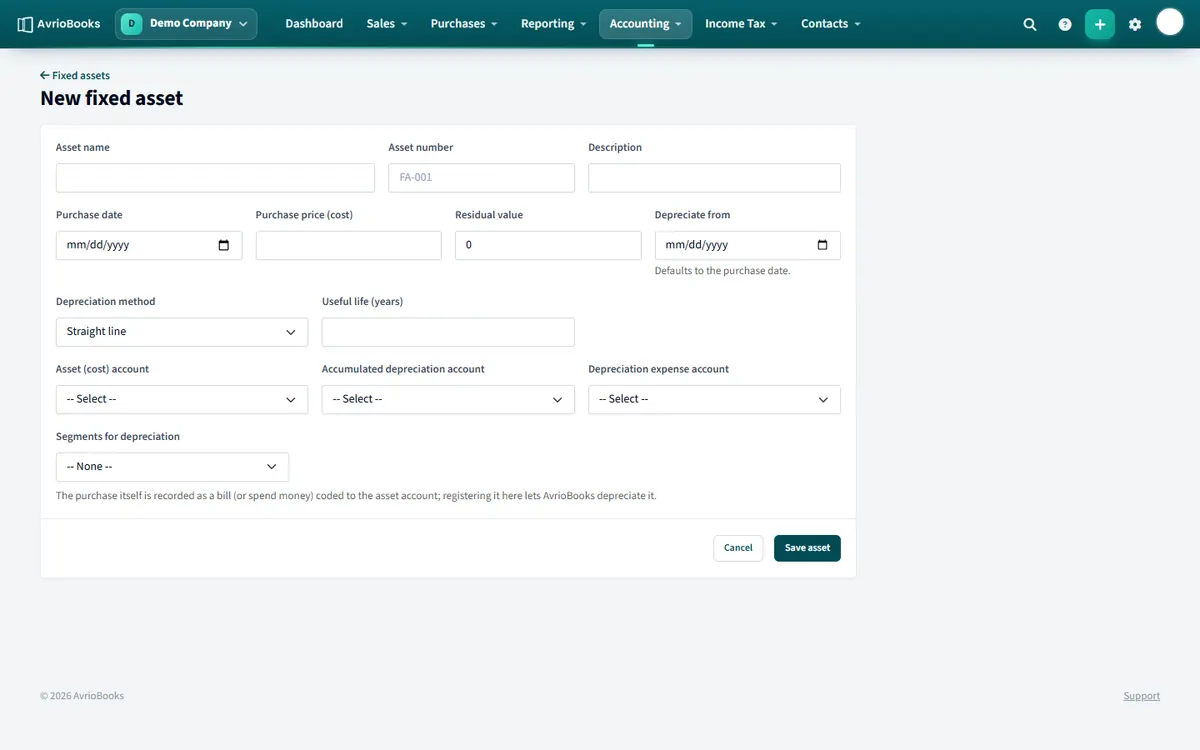
Register an asset
First record the purchase as a bill (or spend money) coded to the asset account. Then register it so AvrioBooks can depreciate it.
- Select Accounting > Fixed assets, then Add asset.
- Enter the name, purchase date, purchase price and residual value.
- Set Depreciate from. It defaults to the purchase date.
- Choose the depreciation method: straight line (enter the useful life in years), diminishing balance (enter an annual rate) or no depreciation.
- Choose the asset (cost) account, the accumulated depreciation account and the depreciation expense account, and any segments.
- Save. The asset page shows the full depreciation schedule, with posted months marked and the rest projected.
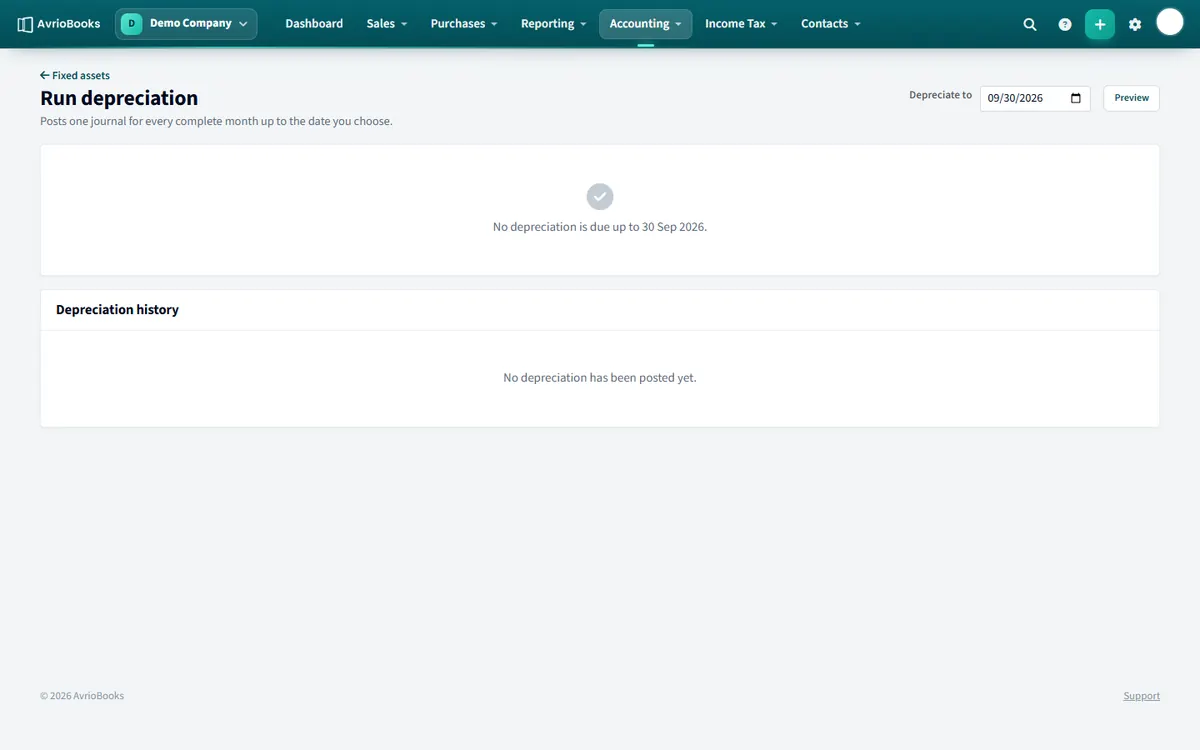
Post depreciation
- Select Run depreciation.
- Choose the date. AvrioBooks posts one journal for every complete month up to it.
- Select Post depreciation. Past runs are listed under Depreciation history.
Dispose of an asset
Open the asset and choose Dispose. Depreciation is brought up to the disposal date, then cost and accumulated depreciation are removed and the gain or loss is booked. Optionally choose the bank account the proceeds were received into.
The Fixed Asset Schedule report shows the cost and depreciation roll-forward for every asset.
A worked example
You buy a laptop for 1,200 with an expected residual value of 200, and choose straight line over 5 years. The amount to depreciate is 1,000. Each month AvrioBooks charges 1,000 ÷ (5 × 12) = 16.67, which is 200 a year. After 24 months the accumulated depreciation is 400 and the book value is 800.
Diminishing balance
With a diminishing balance rate of 25% a year, each month’s charge is the current book value × 25% ÷ 12. The charge is higher at first and falls as the book value falls. In either method the charge never takes the asset below its residual value.
Good practice
- Register an asset in the month you buy it so the first depreciation runs correctly. Depreciate from lets you start later.
- Run depreciation monthly, for example as part of month end, rather than once a year.
- You can only delete the most recent depreciation run. Remove later runs first, working backwards.
- Use the Fixed Asset Schedule report to give your accountant the cost and depreciation roll-forward.
Frequently asked questions
Which depreciation methods are supported?
Straight line (with a useful life in years), diminishing balance (with an annual rate) and no depreciation.
What happens when I dispose of an asset?
Depreciation is brought up to the disposal date, cost and accumulated depreciation are removed and the gain or loss is booked. Proceeds can go to a bank account.